From Parks to Prevention: Positioning Nature as Core Public Health Infrastructure in Canada’s Next Budget Cycle

Blog Post by Dr. Owen Wiseman, ND (Advisor, NatureQuant)
Canada’s most recent federal budget signaled a clear shift.[1] Namely an increased focus on the sustainability of our healthcare system and developing climate resilience through smarter community infrastructure. Billions are being committed toward adaptation and health system pressures. However, one of the most cost-effective, scalable solutions remains largely underleveraged.
Nature.
Parks and recreation have historically been funded as community amenities. But the evidence, and increasingly the economics, suggest they should be treated as preventative health infrastructure. Canada’s latest national nature strategy positions our environment as foundational to human well-being.[2] The question is no longer whether nature matters, but whether we are ready to operationalize it.
A Converging Crisis (and Opportunity)
Canada faces three converging pressures:
- Rising healthcare expenditures driven by chronic disease and aging populations[3]
- Increasing climate risks, including extreme heat and air quality events[4]
- Persistent health inequities across communities[5]
At the same time, Canadians are more disconnected from nature than at any point in history. Modern lifestyles have shifted us indoors for more than 90% of our lives, with measurable consequences for physical and mental health.6
In my own clinical practice, these pressures are anything but abstract. Patients struggling with chronic stress, poor sleep, cardiometabolic disease, and anxiety are often navigating environments that actively work against their health. Some have been failed not by a lack of care, but by a system that is stretched thin. One that is largely designed to respond once illness has already taken hold.
The result is a system on the brink.[7]
Nature-based infrastructure offers a rare solution in that it addresses all three pressures simultaneously.
The Economics. No Longer Theoretical.
The relationship between nature and health is well established. What is newer is the ability to quantify this relationship in economic terms.
Large-scale population data show that individuals living in greener areas have significantly lower healthcare costs. In one study of over 5 million individuals, those in the highest green exposure areas had approximately $374 USD (~$500 CAD) lower healthcare costs per person per year. This was largely driven by reductions in hospitalizations and emergency visits.[8]
At scale, this becomes material.
When applied across populations, even modest increases in nature exposure translate into meaningful reductions in system-wide healthcare expenditures. Not to mention, simultaneously improving quality of life.[9]
From Measurement to Forecasting: The Role of Nature-Based Data
A central pillar of Canada’s nature strategy is improving how we map, measure, and integrate nature into infrastructure and investment decisions. Historically, this has been a barrier and generates a number of questions.
How much nature is enough? Are we underinvesting? Where should investments go? What is the return? Who’s actually benefitting?
Nature quantification frameworks are beginning to answer these questions. Tools like NatureScore translate environmental conditions (i.e. tree canopy, parks, noise pollution, air quality, built form) into a health-optimized metric of nature exposure.[10] This enables direct comparison across communities and identification of “nature gaps.” But more importantly, these frameworks extend beyond measurement into forecasting.
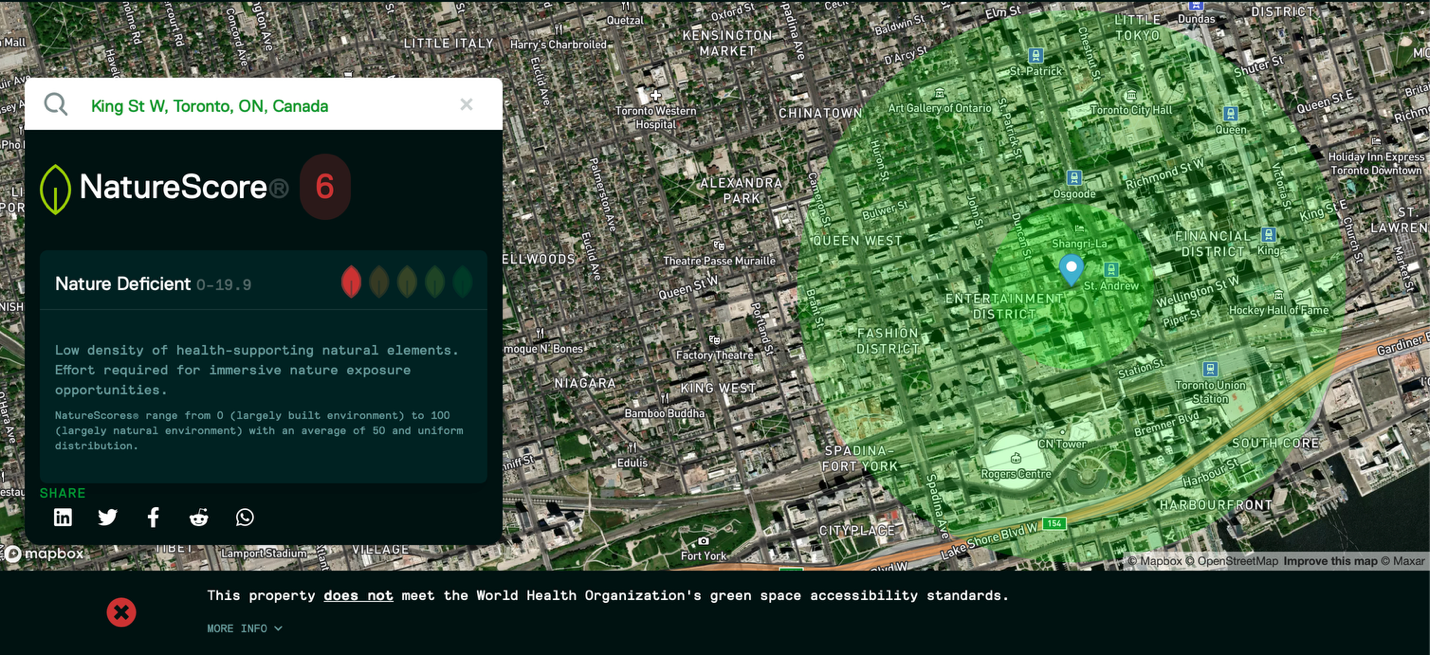
Figure 1. NatureScore® analysis of Toronto’s King Street West corridor, illustrating how dense urban environments can remain functionally “nature deficient” despite proximity to parks and isolated green spaces. The mapped area received a NatureScore® of 6, indicating low density of health-supporting natural elements and failure to meet World Health Organization green space accessibility standards.
Using models like the Tree Value of Statistical Life (TVSL), it is now possible to estimate:
- The life expectancy gains associated with incremental increases in nature exposure[11][12]
- The population-level health impact of specific interventions (e.g., tree planting, park expansion)
- The economic value of those gains using established Value of Statistical Life methodologies[13]
For example, a single urban tree, depending on context, can generate tens of thousands of dollars in health-related economic value over time, with significantly higher returns in nature-deprived communities.
This introduces a commanding planning insight. The marginal health return on nature investment is highest where nature is currently lowest. In other words, equity-focused investment is not just socially responsible, but it is economically optimal.
An Infrastructure Gap Hidden in Plain Sight
Canada’s infrastructure conversation has traditionally focused on car-focused transit and utilities.14 But when viewed through a public health lens, there is a parallel infrastructure gap. Namely, the nature access gap.
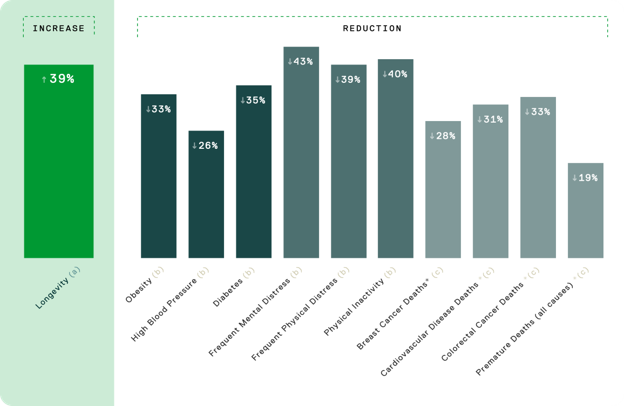
Figure 2. Illustrative associations between higher NatureScore™ environments and improved population health outcomes. Compared with lower-scoring environments, higher NatureScore™ areas demonstrated associations with increased longevity (+39%) and reductions in obesity (−33%), diabetes (−35%), frequent mental distress (−43%), physical inactivity (−40%), cardiovascular disease mortality (−31%), colorectal cancer mortality (−33%), and premature death from all causes (−19%). Percentages represent standardized effect sizes comparing upper and lower NatureScore™ quintiles, calculated as the standardized mean difference divided by the pooled standard deviation. These findings highlight the potential this technology to help identify where investments in green infrastructure may yield meaningful public health benefits.
Two communities may have similar population sizes and built infrastructure, yet vastly different exposure to green space and other restorative environments. These differences translate into measurable disparities in health outcomes and heat vulnerability.
By integrating CPRA’s infrastructure dataset with NQ metrics, Canada has an opportunity to:
- Identify where infrastructure exists but lacks health-promoting quality
- Prioritize investments based on community impact
- Align recreation funding with healthcare cost containment strategies
This is a shift from inventory-based planning to outcome-based planning.
Aligning with Federal Priorities
Importantly, this reframing aligns directly with current federal priorities:
- Healthcare sustainability: Reducing downstream costs through upstream prevention
- Climate adaptation: Leveraging green infrastructure to mitigate heat and air pollution
- Equity and inclusion: Targeting underserved communities with the greatest need
- Economic productivity: Healthier populations contribute more effectively to the workforce
Nature-based infrastructure is one of the few interventions that delivers across all four.
Next Steps
If parks and recreation are to be treated as public health infrastructure, they must be reflected accordingly in budget frameworks.
1. Establish a “Nature as Health Infrastructure” Funding Stream
- Dedicated federal funding envelope aligned with healthcare cost reduction and climate adaptation
- Eligible projects: urban tree canopy expansion, park development, green corridors, schoolyard greening
2. Integrate Nature Metrics into Infrastructure Decision-Making
- Require incorporation of nature exposure metrics (e.g., NatureScore or equivalent) in federally funded projects
- Shift from asset-based reporting (number of parks) to outcome-based metrics (health impact, exposure quality)
3. Target High-Need, High-Return Communities
- Prioritize funding to low-NatureScore / high-deprivation areas
- Leverage the forecasting capabilities to maximize marginal health and economic returns
4. Pilot Health System Integration
- Fund pilot programs linking healthcare systems with nature prescriptions (e.g., PaRx)
- Integrate NatureScore as an environmental determinant of health in electronic medical software’s
- Track reductions in healthcare utilization and costs as part of evaluation
5. Embed Nature in Climate Adaptation Funding
- Recognize urban canopy and green space as core climate infrastructure (heat mitigation, air quality buffering)
- Align with existing federal climate resilience and disaster mitigation funds
6. Standardize Economic Valuation of Nature-Based Interventions
- Adopt frameworks like TVSL to quantify health-related economic benefits in cost-benefit analyses
- Enable inclusion of nature investments in Treasury Board economic evaluations
7. Support National Data Integration
- Fund integration of CPRA infrastructure database with health and environmental datasets
- Enable continuous monitoring of nature exposure and health outcomes
In Closing.
Canada is already investing billions in managing the consequences of inadequate planning. The opportunity now is to invest upstream, and with the tools now available to measure and forecast its impact, we can move beyond intuition and into precision.
Specifically, designing communities not just for where people live, but for how long, and how well, they live there.
References
- Department of Finance Canada. (2025). Budget 2025: A Plan to Build Canada Strong. Ottawa, ON: Government of Canada.
- Government of Canada. (2026). A Force of Nature: Canada’s Strategy to Protect Nature. Gatineau, QC: Environment and Climate Change Canada.
- Vos, Theo, et al. "Global burden of 369 diseases and injuries in 204 countries and territories, 1990–2019: a systematic analysis for the Global Burden of Disease Study 2019." The Lancet10258 (2020): 1204-1222.
- Berry, Peter, and Rebekka Schnitter. "Health of Canadians in a changing climate: advancing our knowledge for action." Ottawa, ON: Government of Canada10 (2022): 329522.
- Raphael, Dennis. Social determinants of health: Canadian perspectives. Canadian Scholars’ Press, 2016.
- Klepeis, Neil E., et al. "The National Human Activity Pattern Survey (NHAPS): a resource for assessing exposure to environmental pollutants." Journal of Exposure Science & Environmental Epidemiology3 (2001): 231-252.
- Hajizadeh, Mohammad, and Faramarz Jalili. "Addressing healthcare waiting time challenges in Canada: insights from emerging initiatives." International Journal of Health Policy and Management14 (2025): 8986.
- Van Den Eeden, Stephen K., et al. "Association between residential green cover and direct healthcare costs in Northern California: An individual level analysis of 5 million persons." Environment International163 (2022): 107174.
- Patwary, Muhammad Mainuddin, et al. "The economics of nature's healing touch: A systematic review and conceptual framework of green space, pharmaceutical prescriptions, and healthcare expenditure associations." Science of the Total Environment914 (2024): 169635.
- Browning, Matthew HEM, et al. "Quantifying nature: introducing NatureScoreTM and NatureDoseTM as health analysis and promotion tools." American Journal of Health Promotion1 (2024): 126-134.
- Gascon, Mireia, et al. "Residential green spaces and mortality: a systematic review." Environment International86 (2016): 60-67.
- Connolly, Rachel, et al. "The association of green space, tree canopy and parks with life expectancy in neighborhoods of Los Angeles." Environment International173 (2023): 107785.
- Becerra-Pérez, Luis Armando, et al. "Value per Statistical Life at the Sub-National Level as a Tool for Assessing Public Health and Environmental Problems." INQUIRY: The Journal of Health Care Organization, Provision, and Financing61 (2024): 00469580241246476.
- Hicks, Anne, Laleh Behjat, and Merkebe Getachew Demissie. "Showing up for no-shows: Why transportation equity matters." Paediatrics & Child Health6 (2025): 439-441.


